 AI Communications





Cold calling has always been a challenging part of outbound sales. Most prospects don’t welcome unexpected interruptions, and sales representatives often face low response rates when reaching out to unfamiliar contacts. Yet despite these challenges, cold calling remains an effective way to generate leads, build relationships, and create new business opportunities.
How can businesses enhance success rates and connect with more promising prospects? AI cold calling has entered the chat. It’s an outbound sales approach to help your agents work smarter, accomplishing more with less effort.
Key takeaways
- Traditional cold calling relies on individual talents and abilities. AI cold calling levels the playing field by streamlining sales activities.
- AI cold calling can mean either automated bots and robocalls or AI that streamlines and enhances outbound sales.
- Conversational AI technologies such as NLP, speech recognition, LLMs, and sentiment analysis can work together to enhance every aspect of the cold calling process, ultimately transforming cold outreach into data-driven, high-converting conversations.
- AI cold calling benefits include greater efficiency, easy call personalization, and data-driven insights.
- Implementing AI successfully requires clear objectives, team buy-in, and choosing the right software. It also requires continuous performance monitoring and adjustments.
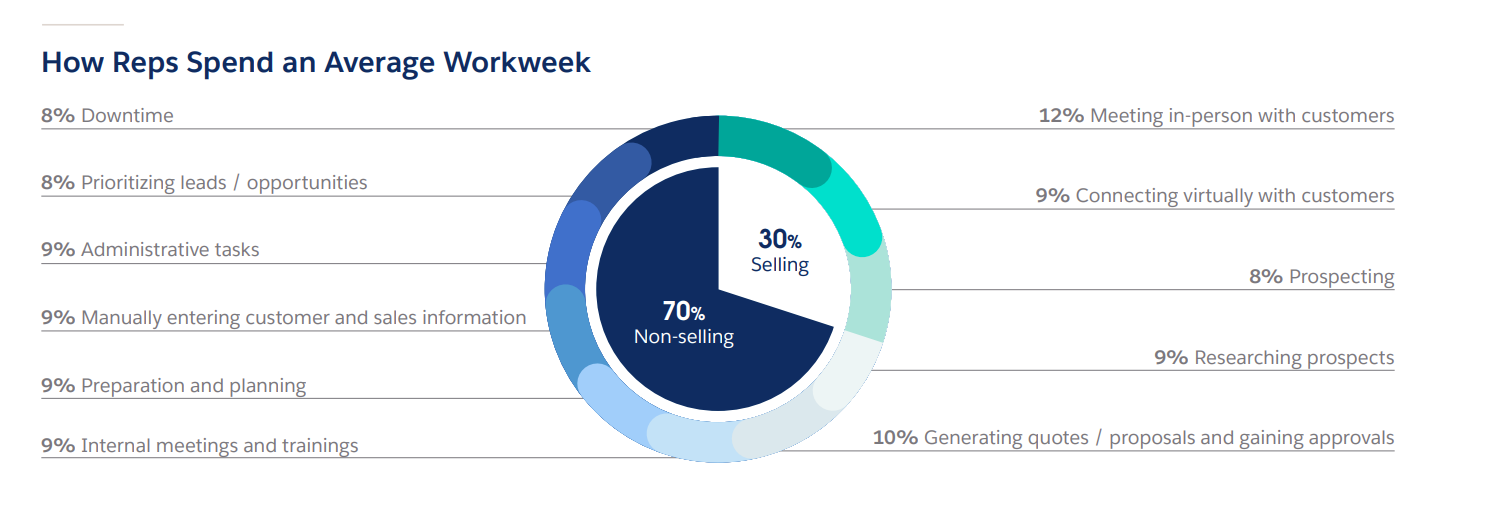
- Salesforce reports reps lose 70% of their time to admin work. AI reclaims it for selling.
What is AI cold calling?
AI cold calling uses artificial intelligence to enhance the outbound sales process. Using emerging technologies, businesses can improve efficiencies, gain insights, and discover better prospects.
When discussing AI cold calls, we must differentiate between the two approaches. The first one is based on fully automated AI cold caller bots. These virtual representatives replace your human team members. They handle everything from information gathering to making a call and interacting with the prospect.
Automated AI cold calling minimizes human involvement, which has its pros and cons. It creates a streamlined and cost-effective outbound calling process. However, AI representatives lack emotional intelligence and the personal touch that customers expect.
The alternative and more favorable approach to AI cold calls is a collaborative one. AI works with your SDRs, enhancing performance and the customer experience (CX).
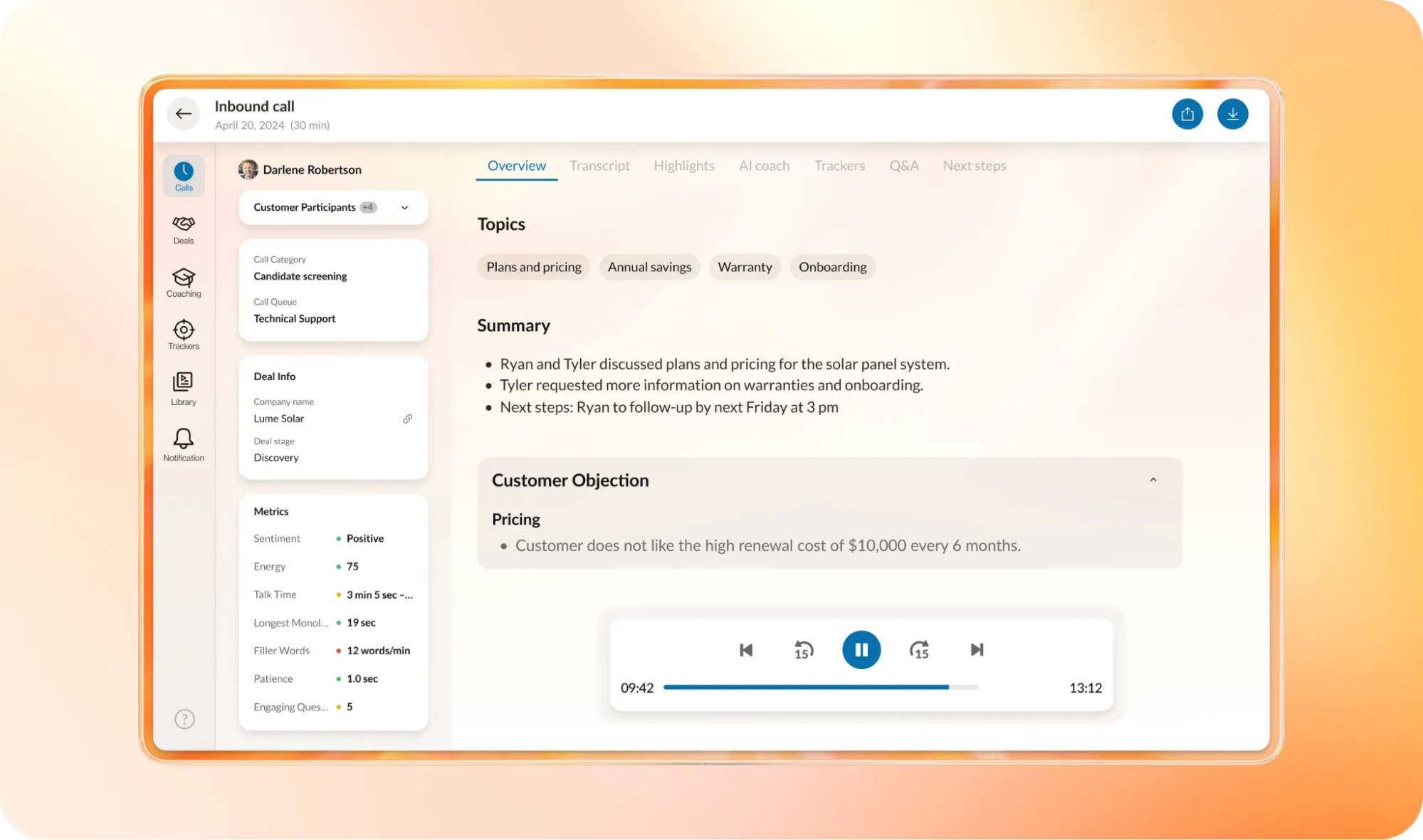
Conversation intelligence tools support your team in several ways, such as taking over information gathering and providing live coaching during a call. Sales AI software can also transcribe conversations and personalize sales playbooks.
While both sides of AI cold calling have their merits, using AI to enhance your team is the synergistic choice. It preserves the all-important human touch when making outbound sales calls. The AI takes over the vital yet boring stuff. Your team gets to focus on what they do best, building connections and nurturing relationships.
Conversational AI in cold calling & more: The tech involved in AI cold calling
Implementing a call AI strategy requires several technologies. While conversational AI for cold calling is the heart, many other components enhance every part of the outbound sales process.
- Conversational AI technologies – These technologies include natural language processing (NLP), speech recognition, text-to-speech (TTS), and large language models (LLMs).NLP is like the brain of conversational AI. It enables it to comprehend and generate human-like responses for fluid conversations. Speech recognition “listens” to the call. It accurately transcribes spoken language into text for real-time analysis and data capture. Likewise, TTS handles the job of turning text into natural-sounding spoken words.
- Predictive analytics – Uses historical data to make forecasts, such as identifying prospects most likely to convert. Historical data analyzed includes demographic, behavioral, and conversational information.By leveraging predictive models, sales teams can focus on high-potential leads. They maximize efficiency and fuel the pipeline with better leads, improving conversion rates.
- Sentiment analysis – Further refines interactions by assessing emotional tone during conversations. AI tools analyze verbal cues and language patterns to determine a prospect’s mood or attitude.On-the-spot AI-assisted coaching and tips guide reps to tailor their approach accordingly. A more personalized interaction increases engagement and fosters stronger relationships.
- Machine learning (ML) – Machine learning (ML) algorithms underpin these technologies by enabling AI tools to learn over time. It performs continuous analysis of call outcomes, conversation patterns, and sales metrics.ML analysis generates insights that fine-tune strategies and improve call success rates. For example, a conversational AI solution can analyze a discussion and adjust a customer scorecard in real-time.
- AI automation – Streamlines post-call workflows and routine tasks. Tools like AI Conversation Expert can automatically update CRM records. They also create call summaries and generate personalized follow-up emails.An AI sales agent handles these repetitive tasks and more efficiently. Your sales team is free to focus on more strategic and higher-value activities. AI automation relieves the burden of repetitive admin tasks while reducing human error.
Various AI sales enablement and cold calling tools use some or all of these technologies. The key is to use the right tools that balance efficiency with personalization. The ultimate goal of AI cold calling is to empower your agents, improve the CX, and increase conversions.
Not an AI calling bot: The areas of outbound sales where AI can help
AI is transforming outbound sales, but not by replacing sales development representatives with automated callers. Its greatest impact comes from helping teams work smarter, engage prospects more effectively, and make better decisions throughout the sales cycle.
AI-powered lead generation and qualification
Successful outbound sales starts with finding the right prospects. AI helps sales teams identify and prioritize high-potential leads by analyzing customer data, engagement signals, demographic data, and historical sales outcomes.
Instead of spending valuable time manually researching prospects, sales teams can focus on accounts that are more likely to convert. This improves pipeline quality, increases productivity, and helps teams allocate their efforts where they can have the greatest impact
AI outreach tools to personalize interactions
Every potential customer is as unique as the SDR who contacts them. While AI may lack emotional intelligence, it’s great at analyzing data from your CRM and other sources for deeper insights.
AI outreach tools can personalize scripts, offers, and sales playbooks pre-emptively and on the fly. Your team can spend more time engaging in outreach calls. When needed, they can consult AI coaching tips for better customer engagement and higher win rates.
Automation of outbound sales processes for efficiency
In the Salesforce State of Sales report, respondents stated they spent 70% of their time on non-selling activities. These tasks include admin, preparation, and manual data entry.
AI automation tools take over mundane and time-consuming tasks so your team can do what they do best: sell.AI Conversation Expert, for instance, can help analyze conversations automatically. Such tools can also help keep your CRM up to date, all but eliminating post-call work. Less to do after a call means more time to connect with another prospect.
AI-driven coaching and sales enablement
AI for sales enablement and coaching can also prove highly valuable, thanks to things like real-time sentiment analysis and feedback during calls.
AI tools can suggest improvements to sales techniques by listening to verbal cues, tone, and what the caller says. Immediate guidance helps your sales reps refine their skills and adapt their strategies on the go.
AI cold call training ensures your team is always equipped with the best approach for each prospect. Sales managers can monitor conversations with live dashboard reporting. Alerts and notifications let them know when to step in to assist with difficult calls.
Transcriptions and call summaries also give quick overviews and highlight areas for improvement. Sales leaders can use key moments and call recordings as learning opportunities and training sessions.
AI for forecasting and analytics
Data analysis and sales forecasting are complex. AI takes over the hard part of the equation. It examines historical sales data and market trends and identifies trends and patterns. AI predicts future opportunities and challenges, helping your leaders make better informed decisions.
Predictive analytics enables you to meet evolving customer demands and market conditions. Enhanced forecasting capabilities ensure your sales strategies stay aligned with business goals. If predictions don’t look right, you can audit your processes and identify potential issues or opportunities.
For example, using AI analytics, you can predict the best times for SDRs to make calls. You also make accurate quarterly sales forecasts, highlighting if your pipeline is lacking in quality leads.
What are the top-line benefits of AI cold calling
AI is transforming outbound sales by helping teams work more efficiently, engage prospects more effectively, and make smarter decisions based on real-time insights. Rather than replacing sales representatives, AI enhances their ability to connect with prospects and manage outreach at scale.
More efficient sales processes and teams
Using AI for cold calling makes everyone’s lives easier. Platforms like RingCentral RingCX come with many capabilities to streamline outbound sales. An auto dialer scrubs your call lists, prevents misdials, and saves your team time from dialing between conversations.
Real-time AI guides sales representatives to pick up on key topics and provide quick and ready answers for prospects. Creating smoother outreach interactions increases engagement with prospects. Enhanced predictive analytics ensures your SDRs prioritize the best potential leads.
Greater personalization at scale
Personalization has become a key factor in successful sales outreach, but tailoring every interaction manually is difficult, especially when engaging large volumes of prospects.
AI helps sales teams deliver more relevant conversations by analyzing available customer data, previous interactions, and conversation context. During calls, technologies such as speech recognition and sentiment analysis can identify cues that help representatives adapt their messaging in real time. As a result, teams can create more personalized experiences without sacrificing efficiency or scale.
Better data-driven decision making
As markets saturate and become more competitive, data becomes the primary differentiator. The problem: There’s so much information to gather and analyze.
How do you know what’s valuable and what’s just noise? AI cold calling tools capture every conversation to unearth insights buried beneath vast mountains of data.
Your sales leaders gain greater visibility into conversation patterns, common objections, competitor mentions, and buying signals. AI-facilitated insights empower decisions and strategy adjustments with evidence rather than intuition.
AI cold calling tips: How to best implement artificial intelligence in your sales team
At first glance, implementing AI for cold calling can appear overwhelming and cumbersome. Of course, the entire point is to make selling your products more efficient and painless.
You can get off to a great start with AI cold calling by following these best practices:
Be clear on your goals
Any new sales initiative or strategy only achieves success by having clear objectives. What are you hoping to achieve by using AI for cold calling? Is your goal to shorten preparation time and speed up outreach? Is it to find better quality leads and improve conversions?
Using an AI tool for outbound sales can help you improve in more than one area. Create primary and secondary objectives to guide you as you design your AI cold calling process.
For example, if you want to gather better market intelligence, then you should probably focus on predictive analytics and ML. If your main challenge is productivity, go with automation tools that streamline workflows and reduce manual tasks.
Get buy-in from your sales team early
There’s always some resistance to new initiatives and technology. Skepticism can be healthy. It prevents impulsive and uninformed decisions. Leaders need to convince all stakeholders of the benefits of using AI for cold calling.
Sales strategies also work better when feedback flows both ways between management and team members.
Easy ways to increase buy-in and collaboration include:
- Create a cross-functional team to test potential solutions and vouch for them.
- Share success stories from other departments or companies using AI tools.
- Create onboarding and educational materials, such as how-to videos and knowledge bases.
- Be transparent about how AI will use conversational data and measure performance.
- Address fears about job security head-on—you don’t want to replace your team, only help them focus on what they do best!
You’ve built a team that’s driven by results. Take every opportunity to show them how AI cold calling tools will help them meet and exceed sales goals.
Choose the best AI cold calling software
There is a solar system full of AI cold calling solutions orbiting your business. You don’t want to necessarily go with the first one that enters your view. Avoid sinking money and time into the wrong solution by finding platforms that fit your business goals and needs.
Essential features to look for include:
- CRM integrations for automatic account updates that reduce post-call work
- AI sales coaching to deliver consistent and relevant interactions
- Real-time call transcriptions of phone calls and video meetings that include summaries
- Intuitive interfaces that streamline workflows instead of complicating them
- Call analytics to deepen customer insights and understanding
- Robust security and compliance measures for data privacy and protection
- Integrations with other business tools to increase team member productivity
You don’t have to commit to an AI cold calling tool right away. Many providers offer demos and free trials so you can test out features and capabilities. Use this opportunity to ensure you’re making the right choice and going with something that your team will adopt and benefit from.
Continually monitor and improve your AI use
Once your team starts using AI to cold call, it’s not “mission accomplished.” Implementation and adoption are only the beginning.
The most successful businesses treat AI adoption as an ongoing process of refinement and optimization.
You came into this plan with some goals in mind. How can you ensure you are progressing towards those goals, continually improving as a team? You need to monitor the right sales call metrics to keep your finger on the pulse.
AI cold calling metrics to monitor include:
- Average call duration
- Call abandonment rate
- Conversion rates
- Average caller sentiment and engagement levels
- Customer satisfaction (CSAT)
- Sales rep response quality
- Appointment bookings
- Talk-to-listen ratio
- Number of calls per rep, per day
- Lead quality and scoring
- Sales pipeline win rates
- Revenue generated from AI-assisted outreach
You’re likely already tracking call quality and sales metrics with your existing business tools. Establish baselines and compare your post-implementation results. Make any necessary adjustments and continually monitor to improve your team’s use of AI.
AI cold calling: Empower your outbound sales reps with artificial intelligence
Using AI for cold calling doesn’t mean resorting to bots and robocalls that lack emotional intelligence and personal touch. AI Conversation Expert offers capabilities that support and enhance your outbound sales team.
Our conversation intelligence solution helps you and your team work smarter. Let our AI take over manual admin tasks and post-call work so you can focus on nurturing leads and winning deals.
Capture key points from every conversation and update your CRM. Everyone on the team gets access to accurate information. AI Conversation Expert automatically transcribes and summarizes every phone call, video meeting, and email for quick reference.
AI-powered coaching listens to what the caller is saying. It offers timely guidance to help your team deliver consistent, successful pitches.
Automated customer scorecards reflect real-time metrics such as prospect sentiment, patience, energy, and the number of engaging questions. Both reps and managers can consult these metrics and more to make sure every call is tailored to each customer.
Register for a demo today and spend more time building relationships.
AI cold calling FAQs
Is AI cold calling legal?
Yes, AI-assisted cold calling is legal in most jurisdictions. However, you must adhere to telemarketing and robocalling regulations for cold calling. You must also comply with data privacy and protection laws.
Legal compliance includes respecting Do-Not-Call lists, identifying yourself and your company, calling during permitted hours, gaining consent for AI-generated messages, and full transparency about the use of AI.
You may also need to follow specific data privacy requirements as laid down by legislation like CCPA or GDPR. Some locations have more specific disclosure requirements about AI usage. Check your local regulations before using AI for cold calls.
What’s the difference between traditional selling and AI selling?
Traditional selling relies primarily on manual rep intuition and heavy administrative overhead, whereas AI-driven selling automates routine tasks and uses data insights to enable highly personalized, scalable buyer experiences.
How can I use AI for cold calling?
To use AI for cold calling successfully, you should implement a structured, four-step operational framework designed to optimize your outbound sales strategy:
- Establish clear goals by focusing on operational bottlenecks: Identify where your reps lose the most time, whether it is dialing unanswered numbers or manually logging data. Set definitive, measurable objectives, such as using AI parallel dialing to scale live conversations or aiming for a 20% increase in meetings booked.
- Get team buy-in through transparent training: Address rep hesitation by framing AI as a strategy to unburden them, not replace them. Use open training sessions to demonstrate how automated voicemail drops and real-time live coaching cues eliminate cognitive strain and tedious data entry.
- Choose the right software by evaluating the technology: Select sales platforms tailored directly to your defined objectives. Prioritize software that features seamless, native two-way CRM integration to keep your data accurate without manual entry
- Monitor and improve performance using conversation data: Continuously analyze the AI-generated call summaries, transcriptions, and dashboards. Review these data insights weekly to isolate which scripts and objection-handling techniques yield the highest connect-to-meeting conversion rates.
How does RingCentral AI Conversation Expert support cold calling?
RingCentral AI Conversation Expert empowers outbound sales teams to make every cold call more effective. Rather than replacing SDRs with automated bots that can create impersonal experiences, it serves as an AI-powered coaching and guidance tool that helps reps navigate live conversations, handle objections with confidence, surface relevant information in real time, and stay focused on building genuine connections with prospects. During every call, it provides:
- Zero Post-Call Work: Automatically records, transcribes, and summarizes every call, meeting, or email while syncing data directly to your CRM.
- Live AI-Powered Coaching: Listens to live prospect cues and feeds real-time hints and script advice directly to your reps to navigate difficult objections on the spot.
- Automated Customer Scorecards: Evaluates prospect sentiment, engagement levels, and the volume of questions asked, providing sales managers with immediate visibility into pipeline health.
How much does RingCentral AI Conversation Expert (ACE) cost?
RingCentral AI Conversation Expert (ACE) starts at $60 per user per month, with enterprise pricing and additional capabilities available by contacting RingCentral’s sales team. For the latest pricing and plan details, visit the RingCentral AI Conversation Expert pricing page.
Updated Jul 21, 2026


